
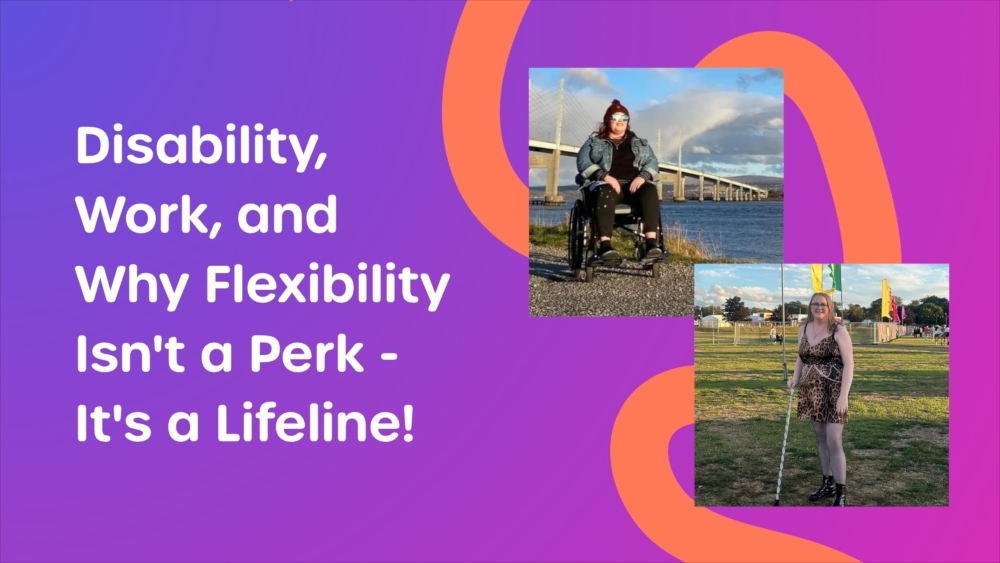
Disability, Work, And Why Flexibility Isn’t A Perk – It’s A Lifeline!
Let’s talk about something that doesn’t get nearly enough airtime in the world of work. This topic is very close to our hearts, and it’s really not spoken about properly.
This isn’t another productivity hack or a LinkedIn hot take about hustle culture. We’re talking about disability in the workplace and the reality of it, the data behind it, and why so many businesses are still getting it spectacularly, frustratingly wrong.
There are trials, there are tribulations – even working from the comfort of your own home. However, there’s also something genuinely transformative happening when people are finally given the space, the trust, and the flexibility to work in a way that actually works for them.
First, the numbers – because they matter
Nearly one in four working-age people in the UK (around 10.4 million) were classed as disabled as of mid-2025. That’s not a niche group. That’s not a minority so small you can afford to quietly ignore it. That’s almost a quarter of your potential workforce, your customers, your clients.
Yet, there’s a disability employment gap. The difference between how many disabled and non-disabled people are in work currently sits at a jaw-dropping 29.5 percentage points. The non-disabled employment rate is 82.3%. For disabled people? It’s 52.8%. There are 218,000 fewer disabled people in work than there were just a year ago.
That’s not a blip. That’s a structural problem, and it’s getting worse, not better.
If that wasn’t enough to make you sit up straight in your (hopefully ergonomic) office chair, here’s another one: the unemployment rate for disabled people is currently 9.2% that is the highest comparable figure since 2019. Researchers from the Work Foundation at Lancaster University have been clear that this isn’t bad luck. It’s the result of limited flexible working, inadequate workplace adjustments, and not enough tailored support for people who need it.
The barriers start before someone’s even walked through the door
Here’s where it gets personal because the data isn’t just about employment rates – it’s about the lived experience of people trying to navigate a system that wasn’t built with them in mind.
Research from the Business Disability Forum found that more than four in ten disabled people said it is harder for them to look for jobs (43%) and attend interviews (43%) than it is for their non-disabled peers. Nearly half (47%) said it is harder to hold down a job once they have one. Almost a third (32%) said they find it more difficult to ask for help from colleagues or a line manager due to fear that they will be perceived as not as capable as others in the workforce.
This leads us to career progression – 46% of disabled individuals feel it is harder to move forward in their careers.
These aren’t abstract statistics, nor are they small enough stats that can be ignored. These are real people. People who are talented, motivated, and capable. These are people who are constantly having to fight a system that asks them to fit in rather than offering to adapt.
When asked what would actually make a difference, the answers were pretty clear:
- 46% said better access to flexible working options
- 40% said better employer understanding of disability
- 25% said a more positive attitude towards employing disabled people
Notice what’s not on that list? A pizza party. A mindfulness webinar. A branded tote bag.
Enter: working from home. The complicated bit.
We’re going to be honest here, because that’s kind of our thing. We love a bit of transparency.
Working from home is not a magic fix, and it’s not for everyone. It comes with its own chaos – the background noise, the lack of separation between your sofa and your desk, the fact that the biscuit tin is now dangerously close at all times. For some people, the isolation of remote working is genuinely hard. The loneliness is real, and the blurred boundaries can be exhausting.
But for many disabled workers? Working from home has been nothing short of life-changing, with data that backs that up.
85% of disabled workers described access to remote and hybrid working as “very important” or “essential” when looking for a new job. A remarkable 80% of disabled workers in fully remote roles said it had a positive impact on managing their health.
The reasons make complete sense when you actually listen to people:
- Autistic workers highlighted the ability to control lighting and noise levels – something that’s nearly impossible in an open-plan office where someone is always microwaving fish
- People with chronic conditions were able to rest or walk around when they needed to, without having to explain themselves in a crowded office
- Those with mobility challenges were freed from exhausting and painful commutes, a lot earlier rises and painful, exhausted nights post-work
- Workers with fluctuating conditions could flex their hours around good days and bad ones, rather than being penalised for either
The TUC research found that around two in three disabled workers (63%) said working from home gave them greater control over their hours, and nearly half (47%) were able to change their routines to better manage their conditions.
This isn’t about people wanting to stay in their pyjamas. This is about people being able to actually do their jobs.
So why are so many businesses still getting it wrong?
That’s the question, isn’t it?
Researchers looked at nearly 95,000 jobs advertised on the DWP’s Find a Job portal between December 2024 and January 2025. Of those, just 3.2% offered hybrid working and 0.6% were fully remote. That’s roughly one in 26 jobs. In a world where remote work is supposedly the norm, that’s a staggering gap between rhetoric and reality.
Add in the wave of “return to office” mandates sweeping through certain industries, and you’ve got a situation where over a million disabled people who currently work from home could see that option stripped away – not because it isn’t working, but because someone in a boardroom decided that proximity equals productivity.
Spoiler: it doesn’t.
What the law says (and what it means in practice)
Right, a bit of the legal side – we’ll keep it non-jargon heavy, don’t worry.
Under the Equality Act 2010, employers have a duty to make reasonable adjustments for disabled workers. That includes considering working from home as a potential adjustment. It’s not optional. It’s not a favour. It’s a legal requirement.
Since April 2024, employees have had the right to request flexible working from day one of a new job. Taking the Employment Rights Act 2025 into consideration, the rules have tightened further. Employers can no longer just tick a procedural box – they now have to demonstrate that any refusal is genuinely reasonable, and employment tribunals can scrutinise that decision properly for the first time.
In plain English, blanket “everyone back to the office” policies are becoming harder to legally justify, which is probably the news some employers needed to hear.
The trials and tribulations – honestly
We’d be doing you a disservice if we made this sound easy.
Working from home when you’re managing a health condition or disability can be brilliant. It can also be relentlessly difficult in ways that aren’t talked about enough.
There’s the equipment problem – not everyone has an ergonomic setup at home, and getting the right support from an employer or through schemes like Access to Work can involve waiting lists that would make the NHS look speedy. There’s the isolation – when your office is also your bedroom, and you’re already managing something that makes socialising harder, the lack of connection can creep up on you. There’s the “out of sight, out of mind” effect – research has shown that people working remotely can miss out on career progression opportunities simply because they’re not visible enough to the right people.
Speaking honestly, we believe constantly having to justify your needs, re-explain your condition, and re-request adjustments every time a new manager comes in is its own kind of exhaustion. It shouldn’t be – but it is.
What good actually looks like
We started Fractly because we believe work should support life, not fight against it. That applies to everyone – but it’s especially true for the nearly 10.5 million working-age disabled people in the UK who deserve a labour market that was actually built for them.
Good looks like:
Genuine flexibility – not flexibility in the brochure and rigidity in practice. Actual trust that people will do great work when given the space to do it on their terms.
Reasonable adjustments that don’t require a battle – implementing support proactively, not reactively. Not waiting for someone to ask for the fifth time.
A culture where disclosure doesn’t feel like a risk – because right now, too many disabled workers stay quiet about their needs because they’re worried about how it will affect their careers. Almost a third say they find it hard to ask for help. That’s a culture problem.
Flexible work advertised upfront – not hidden in the small print of a job spec, or absent entirely. If your role can be done flexibly, say so. You’ll reach talent you’d otherwise never see.
Remote and hybrid options where they work – not as a reluctant concession, but as a genuine feature of how the role operates. If 85% of disabled workers say it’s essential, and you’re not offering it, you are actively excluding a huge pool of brilliant people.
The bottom line
Here’s the thing about disability in the workplace: it’s not a niche issue. It’s not someone else’s problem to solve. Nearly a quarter of the working-age population is disabled. The employment gap is 29.5 percentage points and widening. The fix – more flexibility, better adjustments, genuine inclusion – isn’t complicated or expensive. It’s just a choice.
A choice to trust people, a choice to design work around humans rather than asking humans to fit around a system, and a choice to stop treating flexibility as a perk and start treating it as what it actually is: the baseline.
We’re big believers at Fractly that the future of work has to be built on working with people, not against them. Not on pizza parties offered as substitutions for great work, and not on mandated desk time. Working life should be built on trust, flexibility, and the understanding that people do their best work when they’re actually supported to do it.
Fractly is a fractional marketing team built on flexibility, trust, and no long contracts. If you want marketing support that actually works around your business – and your life – get in touch.
Sources: Work Foundation at Lancaster University (Feb 2026) | GOV.UK Employment of Disabled People 2025 | Business Disability Forum / Fair Play Talks (Dec 2025) | Big Issue / Lancaster University & Manchester Metropolitan University (March 2025) | TUC Disabled Workers & Flexible Working Report | Scope UK | Employment Rights Act 2025